★★★★★
★★★★★
Verified Buyer
Received package quickly..very impressed, especially with the quality of the product. Will definitely continue ordering.
Uso del producto: Este producto está destinado exclusivamente a la investigación.
Toda la información de los productos de este sitio web tiene fines exclusivamente educativos. Cualquier forma de introducción en el cuerpo de personas o animales está estrictamente prohibida por la ley. Este producto solo debe ser manipulado por profesionales autorizados y cualificados. No es un medicamento, alimento ni cosmético y no debe etiquetarse, utilizarse ni presentarse como tal.
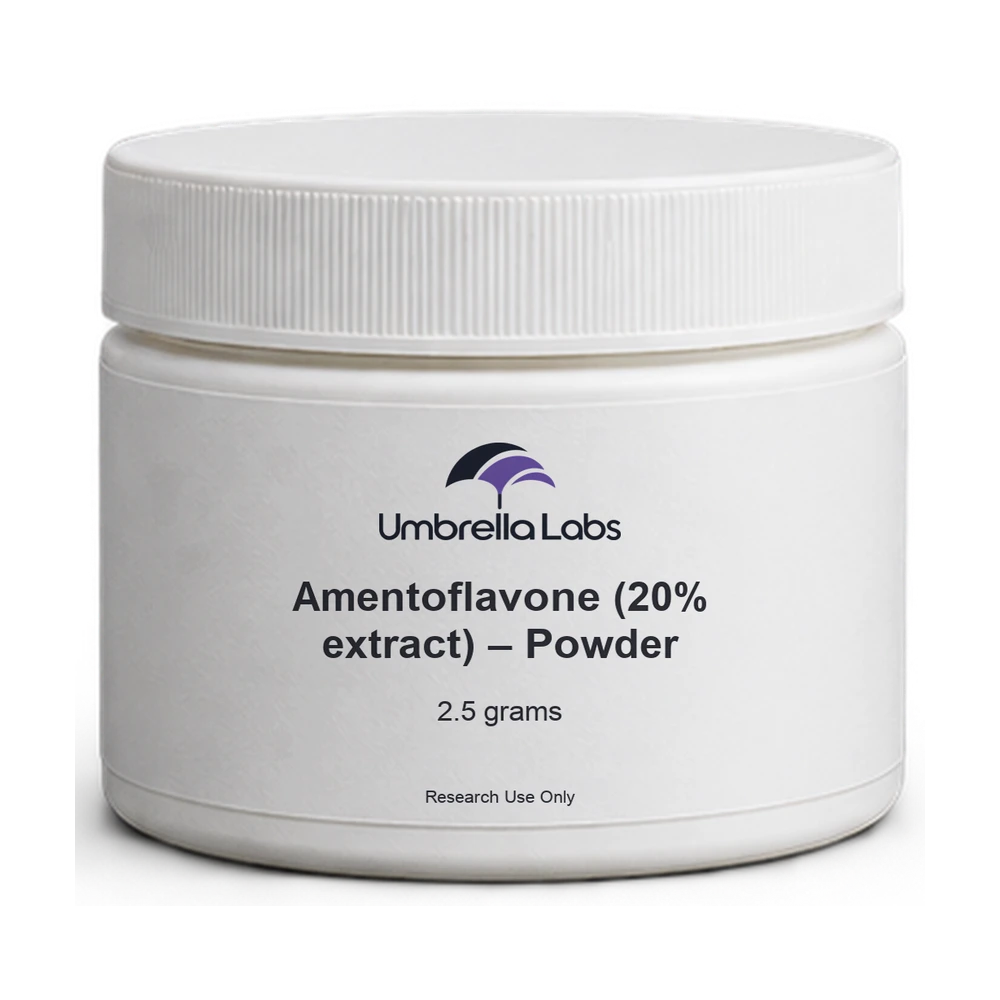
Amentoflavone is a biflavonoid compound composed of two linked apigenin flavonoid units, classified structurally as 3',8''-biapigenin.
Durante el cambio de envase, puedes recibir productos con la etiqueta anterior o con la nueva. La formulación, la pureza y la calidad siguen siendo exactamente las mismas, según nuestros estándares.
-25% en todo – hasta el 31 de octubre
25% sobre los precios habituales, en sustitución de otras ofertas. Acumulable solo con el descuento crypto.
Envío en el día para pedidos en EE. UU. realizados antes de las 12:00 EST.
Ver la política de envíos →Devoluciones sin complicaciones en 30 días para productos sin abrir.
Ver la política de devoluciones →Cada lote se analiza para comprobar su pureza, potencia y calidad.
Ver resultados de laboratorio →Amentoflavone is a biflavonoid compound composed of two linked apigenin flavonoid units, classified structurally as 3',8''-biapigenin. Research interest centers on its receptor-binding profile and enzymatic pathway interactions characterised in controlled in vitro studies, distinguishing it from monomeric flavonoid compounds due to its dimeric structure.
Research applications include biflavonoid structure-activity studies, enzymatic pathway research, and comparative flavonoid dimerization chemistry investigation.
| Chemical Formula | C30H18O10 |
|---|---|
| Synonyms | Didemethyl-ginkgetin, 3',8''-Biapigenin, Amenthoflavone |
| Molar Mass | 538.5 g/mol |
| CAS Number | 1617-53-4 |
| PubChem CID | 5281600 |
| Total Compound Content | 20% extract (2.5 grams) |
| Shelf Life | 36 months |
Every batch is independently lab tested for identity, purity and potency. View our lab testing program →
Amentoflavone consists of two apigenin flavonoid units joined at a specific linkage position (3',8''-biapigenin), creating a larger, more rigid molecular scaffold than monomeric flavonoids. This dimeric structure is studied for how it influences receptor-binding geometry, membrane permeability, and target selectivity compared to the corresponding monomeric apigenin unit, providing a model system for biflavonoid structure-activity relationship research more broadly.
A standardised extract percentage (20% amentoflavone content by weight) ensures researchers can calculate precise active-compound dosing from a consistent starting material, which is important for reproducibility when the extract is derived from plant source material that can have variable natural amentoflavone concentration. Researchers should account for this 20% standardisation when converting total extract mass to active amentoflavone mass for molar concentration calculations in experimental protocols.
Standard approaches include enzyme inhibition assays measuring amentoflavone's effect on relevant enzymatic activity (using purified enzyme preparations and substrate-conversion readouts), alongside receptor or protein-binding assays such as fluorescence polarization or surface plasmon resonance to directly characterise binding affinity. Comparative assays run alongside the monomeric apigenin unit are often used to determine whether the biflavonoid linkage enhances, reduces, or otherwise alters target engagement relative to the parent monomer.
Received package quickly..very impressed, especially with the quality of the product. Will definitely continue ordering.
Superb service and product quality. I’ll be a repeat customer for sure.
Highly satisfied with the ordering process and quality was great and dispatch was incredibly fast. I will definitely be back. The research results have been great so far.
Best ever. Amazing product and will order weekly.