★★★★★
★★★★★
Verified Buyer
Everything that I ordered 'till now was perfect.
Verwendung: Dieses Produkt ist ausschließlich für Forschungszwecke bestimmt.
Alle Produktinformationen auf dieser Website dienen ausschließlich Bildungszwecken. Jede Form der Einbringung in den Körper von Menschen oder Tieren ist gesetzlich streng verboten. Dieses Produkt darf nur von zugelassenen und qualifizierten Fachleuten gehandhabt werden. Es ist kein Arzneimittel, Lebensmittel oder Kosmetikum und darf nicht als solches gekennzeichnet, verwendet oder falsch etikettiert werden.
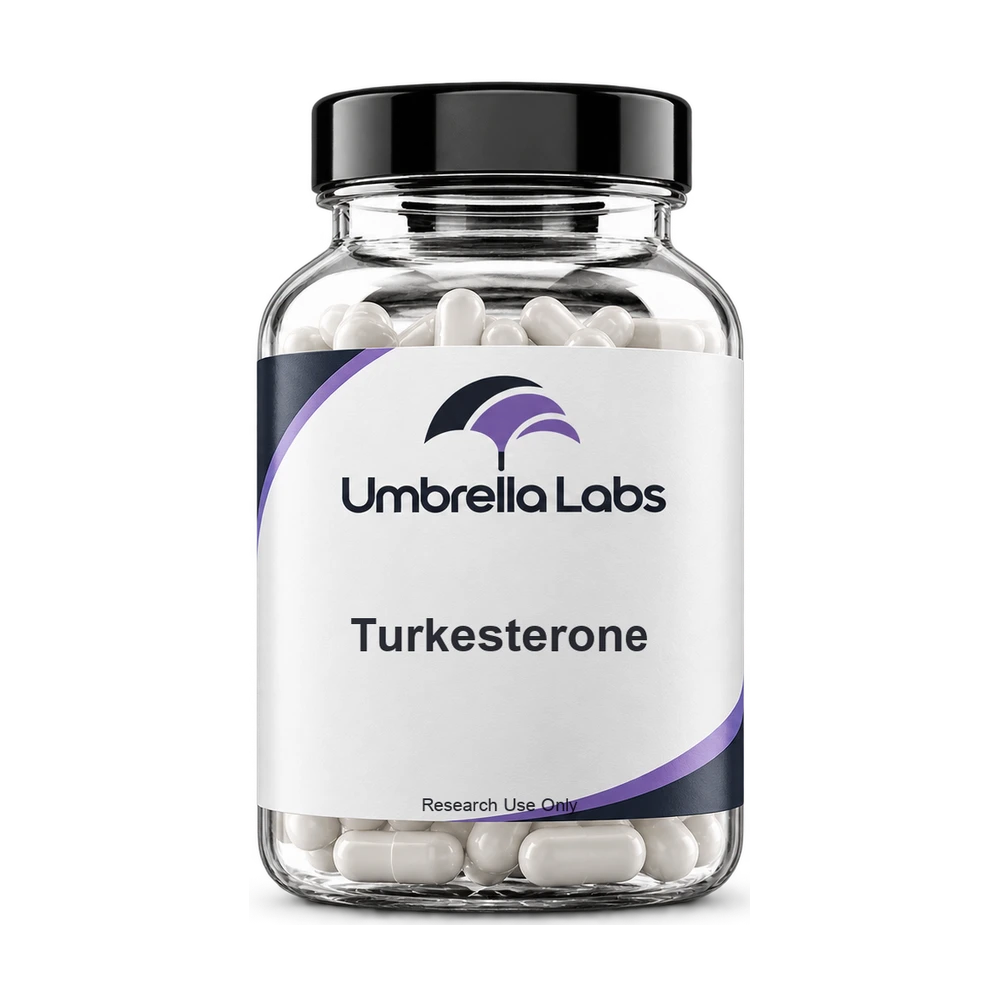
Turkesterone is a naturally occurring ecdysteroid compound. It is isolated from several plant species. This includes Ajuga turkestanica. Ecdysteroids are steroid-like molecules that share structural similarities with insect molting hormones. All of them are commonly studied in biochemical and phytochemical research environments.
Während der Umstellung unserer Verpackung erhalten Sie möglicherweise Produkte mit dem bisherigen oder dem neuen Etikett. Formulierung, Reinheit und Qualität bleiben nach unseren Standards genau gleich.
-25% auf alles – bis 31. Oktober
25% auf reguläre Preise statt anderer Angebote. Nur mit dem Krypto-Zahlungsrabatt kombinierbar.
Jede Charge wird auf Reinheit, Wirksamkeit und Qualität geprüft.
Laborergebnisse ansehen →Turkesterone is a naturally occurring ecdysteroid compound. It is isolated from several plant species. This includes Ajuga turkestanica. Ecdysteroids are steroid-like molecules that share structural similarities with insect molting hormones. All of them are commonly studied in biochemical and phytochemical research environments.
In experimental research, Turkesterone is investigated as a phytoecdysteroid molecule. This is the one that is capable of interacting with ecdysteroid receptor systems and related signaling pathways in controlled laboratory models. Studies of this compound often focus on:
Turkesterone is supplied strictly as a research material intended for laboratory investigation.
Turkesterone has been investigated in experimental assays. This is done for its ability to interact with ecdysteroid receptor complexes (ECR). In vitro studies have shown that the compound may bind to receptor complexes. These are the ones involved in steroid-like signaling pathways within certain biological systems.
As a phytoecdysteroid, Turkesterone possesses a cyclopentaphenanthrene steroid-like ring structure. It also has multiple hydroxyl groups that may participate in hydrogen-bond interactions with receptor sites in biochemical assays.
Researchers analyze these structural characteristics to study how ecdysteroid molecules affect:
Because of its steroid-like scaffold and multiple functional groups, Turkesterone is frequently examined in structure-activity relationship (SAR) investigations. These studies evaluate how modifications to ecdysteroid molecules influence receptor interaction, molecular stability, and ligand binding behavior.
Within controlled laboratory environments, Turkesterone may be utilized for investigations involving:
All applications are limited strictly to analytical and experimental research environments.
Todorova, V., Ivanova, S., Chakarov, D., Kraev, K., & Ivanov, K. (2024). Ecdysterone and Turkesterone—Compounds with Prominent Potential in Sport and Healthy Nutrition. Nutrients, 16(9), 1382. https://doi.org/10.3390/nu16091382
Guibout, L., Mamadalieva, N., Balducci, C., Girault, J., & Lafont, R. (2015). The minor ecdysteroids from Ajuga turkestanica. Phytochemical Analysis, 26(5), 293-300. https://doi.org/10.1002/pca.2563/
| Compound Name | Turkesterone |
|---|---|
| CAS Number | 41451-87-0 |
| Molecular Formula | C27H44O8 |
| Molecular Weight | 496.63 g/mol |
| Chemical Class | Phytoecdysteroid |
| Research Category | Natural steroid-like research compound |
| PubChem CID | 14376672 |
| Source | Plant-derived ecdysteroid (e.g., Ajuga turkestanica) |
Everything that I ordered 'till now was perfect.
Great. I've purchased numerous times.
Very satisfied with my purchase. The product arrived on time and in perfect condition.
Our research results have been outstanding. Great experience with the customer service and purity is outstanding. Highly satisfy and will return.
Outstanding experience with the super fast shipping, purity is outstanding. The experimental results were exceptional. Highly recommend this vendor.
Our research results are completely exceeding expectations. Truly happy with the customer service and the product is of excellent quality. A trustworthy supplier.